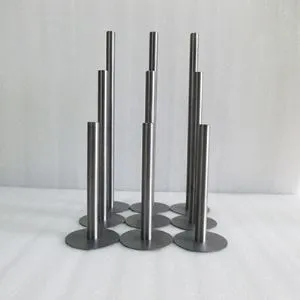
Tungsten electrode is used for TIG welding. It is a tungsten alloy bar made by adding 0.3% - 5% rare earth elements such as cerium, thorium, lanthanum, zirconium and yttrium into the tungsten matrix by powder metallurgy method, and then processed by pressure. The diameter is from 0.25 to 6.4mm, and the standard length is from 75 to 600. The most commonly used specifications are diameter 1.0, 1.6, 2.4 and 3.2. The shape of the electric pole is an important parameter for TIG welding Important factors: when using DCSP, the electrode end needs to be ground into a sharp shape, and its tip angle changes with the application scope, electrode diameter, and welding current. A narrow joint needs a small tip angle. When welding very thin materials, it needs to be carried out with a low current, needle like minimum electrode to stabilize the arc, and an appropriate grounding electrode can ensure easy arc striking and good electric performance Arc stability and appropriate weld bead width. When AC power source is used for welding, it is unnecessary to grind the electric pole, because when proper welding current is used, the electrode end will form a half spherical shape. If the welding current is increased, the electric pole will turn into a bulb shape and may melt and pollute the molten gold.
With the development and application of tungsten inert gas welding, the research of tungsten electrode is more and more in-depth. In the past, thorium tungsten electrode was used in plasma arc welding, cutting and non consumable argon arc welding. However, due to the radioactive effect of thorium (the radiation dose is 3.60 × 10⁵ Curie / kg), it will damage human health and pollute the environment. Therefore, cerium tungsten electrode with cerium oxide content of 2-4% was used instead of thorium tungsten electrode. In direct current direct argon arc welding, the cerium tungsten electrode is easy to start the arc, the electrode burning loss is small, and the allowable welding current density is larger than that of thorium tungsten electrode; while in AC argon arc welding, the cerium tungsten electrode burning loss is larger than that of thorium tungsten electrode, and the allowable welding current range of cerium tungsten electrode is smaller than that of thorium tungsten electrode.
Thorium tungsten electrode is easy to operate and can work well even under overload current. Many people still use this material. It is regarded as a part of high-quality welding. However, people gradually turn their attention to other types of tungsten electrodes, such as cerium tungsten and lanthanum tungsten. Because the thorium oxide in the tungsten thorium electrode produces a small amount of radiation, some welding personnel do not want to get close to them.