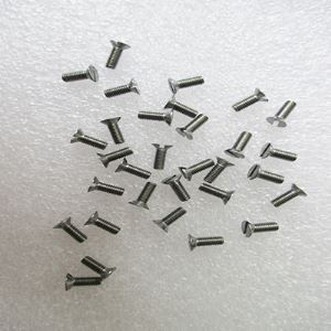
The properties of carbon added to tungsten are similar to that of titanium carbide. The tungsten products are now mainly used as cutting tools in the field of machining. Sintered carbide is neither a metal nor a ceramic product. Cemented carbide is formed by the reaction of carbon and tungsten at 1400-2000 ℃. Because of its hardness as high as 86-93hra (68-81hrc) and its ultra-high wear resistance and high cutting speed, it can no longer be called tungsten alloy but cemented carbide. Cemented carbide has a series of excellent properties, such as high hardness, wear resistance, good strength and toughness, heat resistance, corrosion resistance, etc., especially its high hardness and wear resistance, even at 500 ℃, it is basically unchanged, and still has high hardness at 1000 ℃. Cemented carbide is widely used as cutting tool materials, such as turning tools, milling cutters, planers, drills, boring cutters, etc., for cutting cast iron, non-ferrous metals, plastics, chemical fiber, graphite, glass, stone materials and ordinary steel, as well as for cutting heat-resistant steel, stainless steel, high manganese steel, tool steel and other difficult materials. Now the cutting speed of new carbide tools is hundreds of times that of carbon steel. Cemented carbide also has good crack resistance.
However, due to the brittleness and high hardness of cemented carbide, it is difficult to process cemented carbide, which requires special technology. In contrast, high specific gravity tungsten alloy is easier to process. High specific gravity tungsten alloy can be used as radiation shield, crankshaft and counterweight of tungsten alloy. The reason why these products are made of high specific gravity tungsten alloy materials is that the high specific gravity tungsten alloy has many excellent characteristics, such as good elongation, good corrosion resistance, radiation absorption capacity, etc.